Great Work Is Half the Job. Here Is the Other Half.

Many talented people rarely rise to the top. Politics wins. Visibility beats substance. The game is rigged.
This story circulates endlessly in large organisations. You have heard it. You may have told it yourself. It does two things at once. It protects your identity and releases you from the hardest work. You are not failing. The system is corrupt. The payoff is comfort. The cost is impact. Most talented people make this trade for years without realising they are making it.
The research has been pointing elsewhere for a long time. We have not been willing to look.
The False Dichotomy
We treat pure talent as the gold standard. The brilliant designer. The incisive strategist. The engineer whose code makes colleagues stop and stare. Then we watch as someone marginally less gifted but considerably more savvy gets the budget, the platform, the promotion. We draw the same conclusion every time. Influence corrupts. Politics beats merit.
Nobody asks the more important question. What is talent actually for?
If your work requires no buy-in, no coalition, no translation for people who think differently than you, then you are not operating as a professional. You are a hobbyist with a salary.
Talent is only as valuable as the change it produces. Change in a large organisation does not happen by itself.
What the Research Actually Says
Egon Zehnder, writing in HBR, has spent thirty years measuring leadership potential across thousands of senior hires. Their seven-competency model for predicting success at the top includes results orientation, strategic thinking, and team leadership. It also includes collaboration and influence. Not as a soft add-on. As a core competency, weighted alongside the others. The research dissolved this distinction years ago. We have not updated our thinking to match.
8x | More likely to succeed McKinsey research found that large-scale change efforts using all four influence levers simultaneously were nearly eight times more likely to succeed than those relying on the strength of ideas alone. |
McKinsey's work on organisational transformation makes the same point differently. Large-scale change efforts were nearly eight times more likely to succeed when leaders used all four influence levers together: building conviction, role modelling, reinforcing formal mechanisms, and developing skills. Leaders who relied on the strength of their ideas alone fell behind. A strategy without influence architecture is not poorly executed. It is incomplete.
McKinsey also found that employees now spend roughly 80% of their time collaborating outside their direct reporting lines. In a matrixed organisation, influence is not a supplement to work. It is how work gets done. Talent that fails in this environment is not being suppressed. It is not fit for the context.
Influence Is Not What You Think It Is
The word has been contaminated. We use it to mean office politics, self-promotion, the art of being seen rather than being good. That is the wrong definition and it is where the debate goes wrong.
Influence has a science and an art. Both are worth understanding.
The science is about how people make decisions. Robert Cialdini identified seven universal principles after decades of research: reciprocity, social proof, authority, liking, consistency, scarcity, and unity. These are not tricks. They are learnable disciplines rooted in how people process information and build trust. Trust compounds. People move toward those who understand their actual concerns. The timing of an idea matters as much as the idea itself.
The art is different. It is knowing which principle applies in a specific room, with a specific person, at a specific moment. It is reading whether resistance is about your idea or about something else. It is knowing when to press and when to step back. It is the gap between knowing the principles and knowing how to use them.
Neither is innate. Both can be learned. That makes influence exactly what it is: craft, not character.
Build trust before you need it, not at the moment you need it. That is not politics. That is skill.
I have worked across twenty-five years in contexts where the work spoke entirely for itself and in large technology organisations where a strong idea without a sponsor is just a conversation that never happens. Moving between those two worlds was not a moral compromise. It was a skill expansion.
What Senior Actually Means
We use the word "senior" to denote professional maturity, not just tenure.
Senior does not mean more craft delivered faster. It means you have expanded your definition of craft to include the conditions under which your work lands.
HBR identified a consistent pattern. Organisations assess talent well: skills, expertise, domain capability. They fail to assess whether leaders can create conditions for that talent to produce results. The outcome is predictable. Leaders hired on talent, removed when they cannot operate within complex organisational systems. Not because they lacked capability. Because they were incomplete.
A senior designer who cannot align a product leader has a craft gap, not a politics problem. A senior strategist who cannot translate rigorous frameworks into language a CFO acts on has not finished learning the trade.
Protecting pure talent as a category exempt from the obligation to create change leaves talented people frustrated and organisations underserved.
Influencing Up, Down, and Lateral
Influence is not a single skill applied uniformly. In a large organisation, you need to operate in three directions simultaneously. Each has different mechanics, different currency, and different failure modes.

Most talented professionals are strong in one direction and weak in the other two. Senior individual contributors tend to over-invest in influencing up and neglect both the peers who could champion their work and the people below them who could amplify it. Leaders who have come up through people management are often strong downward but exposed laterally and upward.
Lateral is frequently the hardest. Peers have no obligation to support you. The only lever available is genuine relationship and shared stakes. Most talented people treat this as optional. It is not.
Knowing which direction is your gap is as important as knowing the gap exists.
The Real Enemy
This argument is easy to misread as a defence of the status quo. It is not.
Some organisations have let influence decouple entirely from merit. Tenure, proximity to power, and perception management replace quality of thinking as the basis for advancement. These organisations exist. They waste talent and pay for it over time.
That is a failure of culture and leadership. It is not evidence that influence itself is corrupt. Blaming influence because some organisations misuse it is like blaming communication because some people lie.
The problem is not influence. The problem is influence used to protect individuals at the expense of ideas, users, and the organisation's integrity. That distinction matters. Collapsing it is lazy and self-defeating.
The Talent Completion Model
The talent versus influence debate is not a spectrum. It is a matrix. Two axes: craft and influence. Four positions. Only one of them is complete.
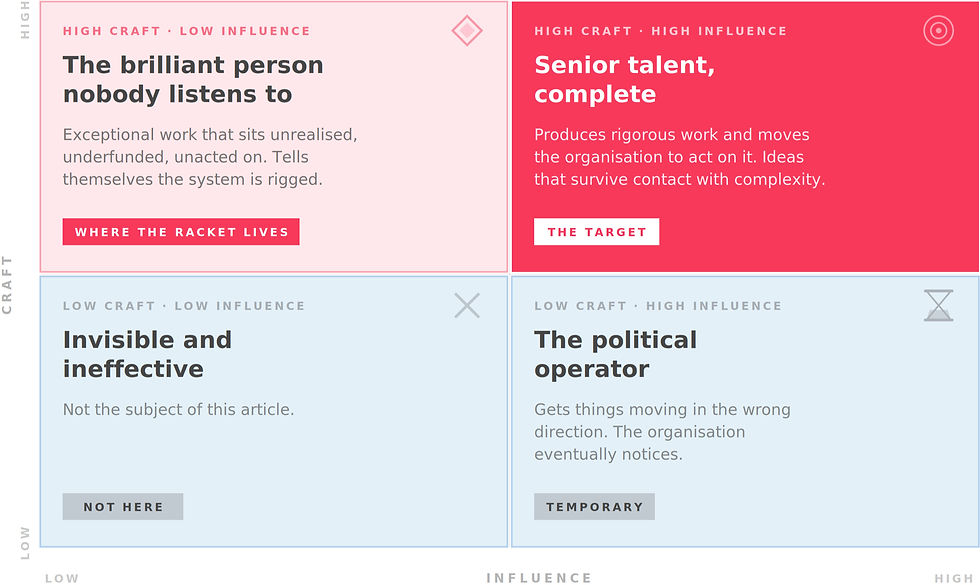
The quadrant you want is not a destination. It is a direction. Most people reading this sit closer to the craft axis than the influence axis and tell themselves that is where integrity lives.
It is not. It is just where the racket is most comfortable.
The Reckoning
If your impact is smaller than your talent warrants, two questions are worth asking honestly.
First: is the organisation genuinely unreceptive to your thinking? If yes, decide whether to stay and fight or leave and build.
Second, harder and more useful: have you developed your ability to bring people with you with the same rigour you brought to your craft?
If the answer is no, start here. Build relationships before you need them. Translate your work into the language of the person across the table, not your discipline. Find a sponsor for an idea before you present it publicly. Learn to read resistance: most of the time it is not about the idea. And identify which of the three directions, up, lateral, or down, is your weakest, then address that one first.
None of this requires you to compromise your standards. It requires you to take the second half of your craft as seriously as the first.
Most talented people put everything into the work and almost nothing into the conditions that allow the work to matter. They treat influence as unnecessary or distasteful. Both positions carry the same cost: permanent underperformance dressed up as principle.
Influence is not the shadow side of talent. It is talent's completion.


Ngày nào mình cũng ngó qua mấy kênh soi cầu XSMB/MB trước giờ quay để bắt nhịp, chứ sát giờ mới xem thì dễ cuống. Mình hay ghép dự đoán XSMB với thống kê lô gan và lô xiên để nhìn ra hướng đi của dàn số, đỡ đoán theo cảm giác. Trong nhóm cũng có người khuyên nên quay thử rồi đối chiếu lại dữ liệu cũ để xem tần suất có hợp lý không, nhất là khi kết hợp thêm vài công cụ kiểu quay thử XSMB hay Rồng Bạch Kim. https://soicauxsmb.pro/ mình chỉ lướt để so sánh thêm thôi, không bao giờ tin mỗi một nguồn. Nói chung dự đoán miền Bắc vẫn phải cân giữa cầu…
Mình mua xổ số chủ yếu cho vui, kiểu có thêm chút hồi hộp chứ không đặt nặng chuyện đổi đời. Trước đây nghe người ta bàn về “cầu kèo” các kiểu, mình cũng nửa tin nửa ngờ, nhưng theo dõi một thời gian thì thấy thỉnh thoảng có vài con số lặp lại làm mình tò mò. Mỗi lần đọc nhận định, mình hay ghi lại vài ý ngắn rồi chờ kết quả để kiểm tra xem có phải mình đang tự gán ghép hay không. https://soicauxsmb.io/soi-cau-xsmb-win2888.html Có bữa trúng được chút thì cũng vui, nhưng nhiều hôm lệch hoàn toàn nên mình tự nhắc là đừng tin quá. Nói chung dự đoán xsmb chỉ để có chuyện tán…